Quick summary
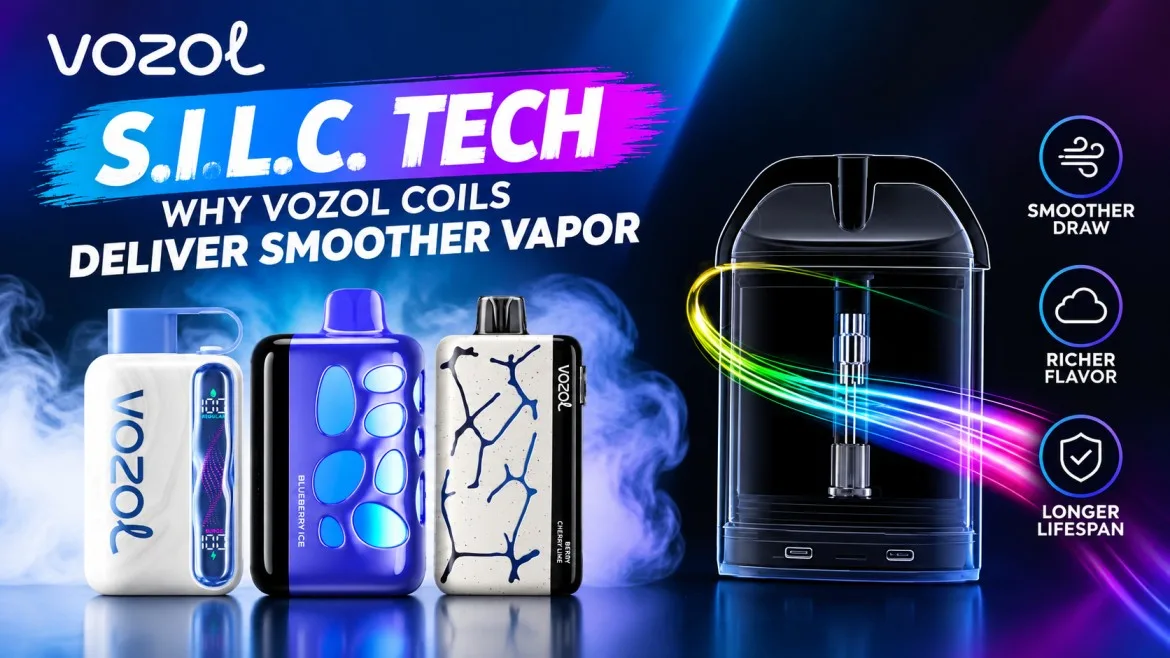
A technical breakdown of VOZOL S.i.L.C coil technology, covering liquid delivery, heating, airflow, vapor density, and how it shapes flavor and smoothness.
Devices covered: VOZOL Star 40000VOZOL Rave 40000VOZOL Gear Shisha 25000
In this article 12 sections
- What Makes a VOZOL Coil Feel Different?
- What Is VOZOL S.I.L.C. Coil Technology?
- How S.I.L.C. Technology Works Inside the Device
- Why Coil Consistency Matters for Smoother Vapor
- S.I.L.C. vs. Conventional Disposable Vape Coil Designs
- Which VOZOL Devices Use This Coil Technology?
- Where VOZOL Salt Nicotine Fits Into the Coil Equation
- What Can Actually Make Vapor Feel Smoother?
- How to Evaluate S.I.L.C. Technology Like a Reviewer
- S.I.L.C. Technology: Benefits and Limitations
- Frequently Asked Questions About VOZOL S.I.L.C. Technology
- Final Takeaway: Understanding the Technology Behind the Draw
Quick answerS.I.L.C. is VOZOL’s coil system that coordinates liquid delivery and heating so vapour and flavour stay consistent across a device’s life. In our range it is used in the Star 12000 (AED 37), Star 40000 (AED 45) and Rave 40000 (AED 55). Other VOZOL models use mesh, dual mesh or ceramic coils. All are sealed, USB-C rechargeable disposables.
What Makes a VOZOL Coil Feel Different?
Ask any regular vaper what makes one device feel better than another, and coil quality comes up almost every time. It’s the part doing the actual work, turning liquid into the vapor you inhale, and it shapes everything from flavor to throat feel to how consistent your draw feels from the first pull to the last. VOZOL’s S.I.L.C. coil technology is the company’s answer to that challenge, and it’s worth understanding in plain terms rather than marketing language.
Coil design affects four things directly: vapor consistency, flavor accuracy, airflow behavior, and throat feel. Get any one of those wrong and you notice it fast, usually as a harsh draw, a flat taste, or a dry hit partway through a session.
This is a technical explainer, not a sales pitch. We’ll walk through how S.I.L.C. actually works, where it fits across the VOZOL vape lineup, and what genuinely affects smoothness versus what’s just marketing language. No unsupported performance promises here, just how the system works and what that means for you.
What Is VOZOL S.I.L.C. Coil Technology?
S.I.L.C. refers to VOZOL’s coil system built around consistent liquid delivery and controlled heating, working together to keep vapor production stable across a device’s full lifespan. Its whole job is coordinating four parts of the system so they work together instead of against each other.
The coil interacts with the e-liquid first, drawing it in through a wicking material. It converts electrical energy into heat once liquid reaches the heating element. That heat vaporizes the liquid, which then mixes with incoming air before you draw it in. Get the balance between these four pieces right, and you get steady vapor production. Get it wrong, and you get the dry, harsh hits everyone hates.
Consistent liquid delivery matters more than people realize. A coil that runs dry, even briefly, produces a burnt taste that ruins the flavor of whatever you’re vaping until it resaturates. Worth being clear about one thing: what follows describes VOZOL’s own manufacturer specifications for how the system is designed to work. It isn’t an independent lab-tested performance claim, and we’re not presenting it as one.
How S.I.L.C. Technology Works Inside the Device
Step 1: E-Liquid Reaches the Coil
Liquid absorption starts the whole process. The wicking material inside the coil pulls e-liquid toward the heating element through capillary action, essentially the same physics that lets a paper towel soak up a spill. Consistent saturation here is what prevents dry hits later in the process. If the wick can’t keep up with how fast you’re drawing, the coil runs short on liquid, and you taste it immediately.
Step 2: The Coil Converts Electrical Energy Into Heat
Once liquid reaches the heating element, an electrical current passes through the coil material and generates heat. No need to get deep into the engineering here, what matters is that this heat needs to spread evenly across the coil surface. Uneven heat distribution creates hot spots, and hot spots are exactly where you get that burnt taste even when the rest of the coil still has plenty of liquid.
Step 3: Vapor Forms and Mixes With Air
As the heated liquid turns to vapor, it needs to mix with incoming air before it reaches your mouth. This is where airflow design becomes just as important as the coil itself. Good airflow gives you a smoother-feeling draw with better vapor density. Poor airflow can make even a well-built coil feel harsh or thin, no matter how good the heating element is.
Step 4: The User Inhales the Vapor
Everything upstream, liquid delivery, heat distribution, and airflow, adds up to what you actually notice: warmth, vapor density, flavor accuracy, and throat hit. This is the point where all that internal engineering either delivers a smooth draw or doesn’t.
Why Coil Consistency Matters for Smoother Vapor
Five factors work together here: temperature consistency, e-liquid saturation, vapor density, flavor stability, and dry-hit prevention. When a coil holds a steady temperature and stays properly saturated, you get consistent vapor density and flavor that doesn’t drift from draw to draw.
Worth saying plainly: “Smoother” is a subjective word. What feels smooth to one person can feel too light to another, and that perception shifts depending on e-liquid formulation, nicotine strength, airflow settings, and individual preference. No coil technology overrides personal taste, it just gives the system a more consistent baseline to work from.
S.I.L.C. vs. Conventional Disposable Vape Coil Designs
Rather than declaring one design an outright winner, it’s more useful to compare what each approach prioritizes.
| Factor | S.I.L.C. Design Approach | Conventional Disposable Coils |
|---|---|---|
| Heating consistency | Built around even heat distribution | Varies widely by manufacturer and price point |
| Liquid delivery | Coordinated wicking and saturation control | Often simpler, less coordinated wicking |
| Flavor reproduction | Aims for stability across the device’s life | Can drift noticeably as the coil ages |
| Vapor density | Paired with airflow design for consistency | Density often tied to raw power alone |
| Coil response | Designed for consistent draw-to-draw feel | Can vary more between early and late use |
| Device longevity | Built to maintain performance through rated puff count | Performance drop-off varies by build quality |
The real takeaway from a table like this isn’t that one design “wins.” It’s that coordinated engineering across liquid delivery, heating, and airflow tends to produce a more consistent experience than any single component working in isolation.
Which VOZOL Devices Use This Coil Technology?
Not every VOZOL disposable uses S.I.L.C. The table below lists the coil type for each model we stock, taken from our product listings.
| Model | Coil | S.I.L.C.? | Price |
|---|---|---|---|
| VOZOL Star 12000 | SiLC coil | Yes | AED 37 |
| VOZOL Star 40000 | Dual mesh (S.i.L.C.) | Yes | AED 45 |
| VOZOL Rave 40000 | Dual mesh, managed by VOZOL’s S.i.L.C. smart chip | Yes | AED 55 |
| VOZOL Gear 10000 | Mesh | No | AED 33 |
| VOZOL Neon 10000 | Ceramic | No | AED 38 |
| VOZOL Vista 20000 | Dual mesh | No | AED 38 |
| VOZOL Gear Power 20000 | Dual mesh | No | AED 33 |
| VOZOL Star 20000 | Mesh | No | AED 43 |
| VOZOL Gear Shisha 25000 | Dual mesh | No | AED 38 |
Star 12000 is the model most closely tied to SiLC. Its 20 ml tank and 650 mAh battery are matched to the coil so the draw stays the same from early puffs to late ones, as long as the battery is charged. Read our VOZOL Star 12000 review for the full specs.
Star 40000 and Rave 40000 pair S.i.L.C. control with dual mesh coils. At 40,000 rated puffs, a steady liquid supply over a long life matters most, and both models switch between a standard and a stronger mode. See our Star 40000 review and Rave 40000 review.
The other models use standard mesh, dual mesh or ceramic coils. Mesh and dual mesh spread heat over a larger surface for fuller vapour. The Neon’s ceramic coil gives a softer, cleaner taste. These are different designs, not lesser ones: the principles in this article (even heating, steady wicking, enough battery) apply to all of them.
If you’re comparing puff counts and trying to figure out which model actually fits your habits, our breakdown of top VOZOL models by value lays that out clearly.
Where VOZOL Salt Nicotine Fits Into the Coil Equation
Nicotine formulation and overall e-liquid composition shape how smooth a vape feels just as much as the coil does, sometimes more. VOZOL’s salt nicotine formulation is designed to deliver a gentler throat feel compared to freebase nicotine at equivalent strength, and that’s a liquid-chemistry factor, not a coil design factor.
This distinction matters because coil technology alone does not determine throat hit. A great coil paired with a harsh e-liquid formulation will still feel harsh. A mediocre coil paired with a well-formulated salt nicotine liquid can still feel smoother than you’d expect. The two systems work together, but they’re not the same thing, and smoother vapour does not mean lower risk. Both salt nicotine and coil design affect how a draw feels, not its risk profile. If you want a closer look at how different flavor formulations compare, five strong salt nicotine flavor picks is worth a read.
What Can Actually Make Vapor Feel Smoother?
If something feels off with your draw, run through this list before assuming the device is faulty:
- Coil saturation. A coil that hasn’t had time to fully saturate, especially early in a device’s life, can feel harsher than it will after a few draws.
- Airflow. Restricted airflow makes a draw feel tighter and often harsher, even with a perfectly good coil underneath.
- E-liquid formulation. Different flavor bases and nicotine types genuinely feel different, independent of the hardware.
- Nicotine concentration. Higher concentrations tend to feel stronger on the throat, regardless of coil quality.
- Inhalation style. A slow, gentle draw feels different from a quick, hard pull, and that’s on the user, not the device.
- Device power. Too little power under-vaporizes the liquid; too much can push past the coil’s ideal range and cause harshness.
- Temperature. Ambient temperature can affect e-liquid viscosity, which in turn affects how well the coil wicks it.
- Device condition. A coil nearing the end of a disposable’s rated life will naturally perform differently than a fresh one.
How to Evaluate S.I.L.C. Technology Like a Reviewer
Want to judge this properly instead of just going by first impressions? Here’s a repeatable framework:
Check consistency from your first draw all the way to your last, not just the first few pulls when everything’s fresh. Assess whether flavor stays stable throughout or whether it drifts and fades unevenly. Observe vapor density and whether it stays steady or fluctuates from draw to draw. Evaluate airflow consistency: does it feel the same on pull ten as it did on pull one? Watch for any changes in draw resistance over time, since that often signals a wicking issue developing. Note any signs of overheating or poor liquid delivery, burnt taste, harsh hits, or thin vapor. And always compare what the manufacturer claims against what you can actually observe yourself, rather than taking spec sheets at face value.
S.I.L.C. Technology: Benefits and Limitations
Potential Advantages
Coordinated design across liquid delivery, heating, and airflow tends to produce more consistent heating, more controlled liquid delivery, more stable vapor production, and steadier flavor consistency than components working independently of each other.
Important Limitations
Performance still depends on the complete device design, not the coil in isolation. A great coil in a poorly designed device won’t save the overall experience. User experience genuinely varies from person to person, and that’s not a flaw in the technology, it’s just how subjective sensory experience works. Manufacturer claims should never be treated as independently verified test results without confirmation. And no coil technology, however well engineered, eliminates the normal risks that come with vaping in general.
Frequently Asked Questions About VOZOL S.I.L.C. Technology
What does S.I.L.C. mean in VOZOL devices?
It refers to VOZOL’s coordinated coil system, which focuses on consistent liquid delivery and controlled heating to help maintain stable vapor production throughout the device’s usable life.
How does S.I.L.C. technology work?
E-liquid is absorbed by the wicking material, the coil converts electrical energy into heat, and that heat vaporizes the liquid. The vapor then mixes with incoming air before you inhale it. Each step depends on the one before it.
Does S.I.L.C. make vapor smoother?
It’s designed to support smoother and more consistent vapor production through coordinated heating and liquid delivery. Actual smoothness can still vary based on airflow, e-liquid formulation, and personal preference.
Does S.I.L.C. improve flavor?
It’s designed to support flavor consistency by helping reduce dry hits and uneven heating. However, flavor perception also depends heavily on the specific e-liquid formulation.
Which VOZOL devices use S.I.L.C. technology?
In our range: the Star 12000 (SiLC coil), Star 40000 (dual mesh S.i.L.C.) and Rave 40000 (dual mesh with an S.i.L.C. smart chip). The Gear 10000, Star 20000, Vista 20000, Gear Power 20000 and Gear Shisha 25000 use mesh or dual mesh coils, and the Neon 10000 uses a ceramic coil.
Is VOZOL S.I.L.C. technology different from traditional coils?
Yes. S.I.L.C. specifically coordinates liquid delivery and heating as an integrated system rather than treating them as separate components.
Does salt nicotine affect how smooth a vape feels?
Yes. Salt nicotine formulation affects throat feel independently of coil technology. Both factors can influence the overall vaping experience.
Why can the same coil feel different with different e-liquids?
Viscosity, nicotine type, and flavor formulation can all affect how e-liquid wicks and vaporizes. The coil may stay the same, but the liquid interacting with it can change the result.
Final Takeaway: Understanding the Technology Behind the Draw
Coil heating, liquid delivery, airflow, and e-liquid formulation all work together to produce what you actually experience in a draw. None of these factors operates alone, and understanding that is more useful than chasing any single spec.
S.I.L.C. should be evaluated as part of a complete device system, not as a standalone feature that guarantees a specific result on its own. The honest technical takeaway is this: coordinated coil engineering gives a device a more consistent foundation to work from, but your actual experience still depends on the e-liquid, your inhale style, and your own preferences layered on top of that foundation.
If counterfeit products are a concern in your area, our guide on spotting fake VOZOL disposables is worth reading before your next purchase, since fake devices skip this kind of engineering entirely. And if you’re still narrowing down flavors to try, our roundup of the best VOZOL flavors in the UAE is a solid next stop.
18+ only. VOZOL products contain nicotine, which is a highly addictive substance.
Best-selling VOZOL vapes
View all